Air pollution is often discussed in numbers — PM concentrations, emission levels, seasonal peaks. Yet public understanding of what these numbers mean, where pollution comes from, and who is responsible for reducing it remains uneven.
Across five municipalities, the clean air process was not only about selecting measures. It was also about raising public awareness in a structured and informed way.
From Perception to Understanding
Many citizens associate air pollution primarily with visible smoke — chimneys, industrial stacks, or burning waste. However, survey on the perception of citizens and representatives of local governments and public institutions regarding air pollution issues, conducted across the five municipalities revealed a more nuanced and sometimes contradictory reality.
While a large majority of respondents (between 66% and 80% in four of the five municipalities) consider air pollution a serious problem, the research shows that citizens tend to underestimate the impact of their own household heating practices. For example, despite wood being the most commonly used heating source (ranging from 41% to 53% of households depending on the municipality), nearly half of respondents in some cities do not perceive wood burning as a significant contributor to poor air quality. At the same time, many respondents identified burning waste and industry as primary pollution sources, while ranking household heating much lower.
This gap between awareness and behavioral change became a central insight for the process that followed.
Evidence as a Catalyst for Awareness
To complement the perception survey, the results of the one-year air quality monitoring conducted by the AMBICON laboratory at University “Goce Delchev” in Shtip were publicly presented in each municipality.
These presentations were not limited to technical reporting. They were organized as open sessions at the Community Forums, where scientific findings were introduced directly to local audiences — including municipal staff, representatives of public enterprises, civil society organizations, and residents.
In this way, science was brought closer to the community.
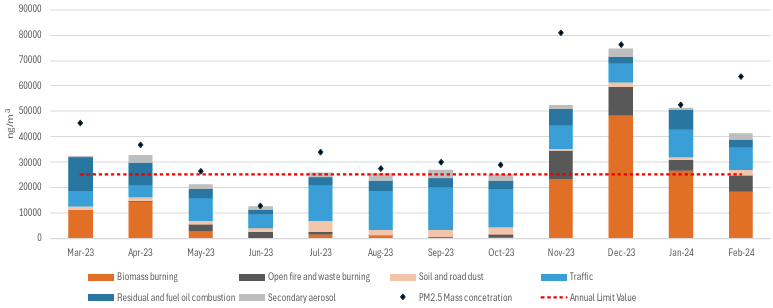
The monitoring results identified key local pollution sources — biomass burning, traffic, residual and fuel oil combustion, road and soil dust, open fire and waste burning, secondary aerosol. Presenting these findings publicly ensured that discussions were grounded in measured evidence rather than assumptions.
Multi-Level Engagement: Community and Institutions
The public presentations created a shared space where different perspectives could intersect.
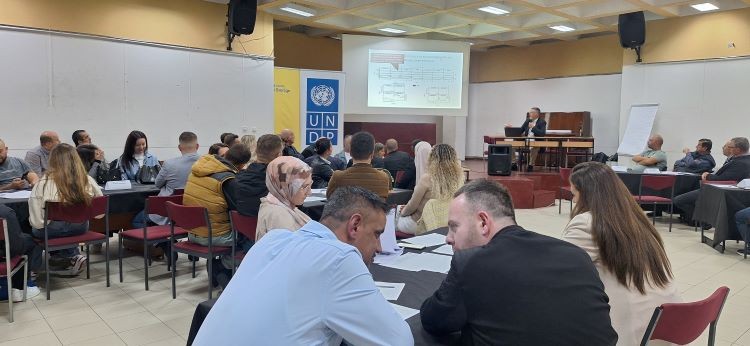
Municipal administration staff and public enterprises participated alongside residents and civil society representatives, creating a shared space for cross-sector dialogue. This was particularly important, as municipal actors operate at multiple levels — planning, service delivery, inspection, infrastructure management — and can influence air quality both directly and indirectly.
At the same time, they are also members of the same communities.
Bringing these groups together ensured that awareness was not confined to one segment of society. It extended across governance levels, from community members to local decision-makers and operational staff. The discussion therefore unfolded across layers of responsibility — individual, institutional, and systemic.
Structured Information as a Public Good
Public awareness does not increase automatically with the availability of data. It requires structure, continuity, and open communication among all relevant actors.
When information is shared transparently and discussed collectively, it becomes more than technical content — it becomes a public good.
By presenting survey findings, monitoring results, Air Quality Plans, and potential mitigation measures within the same framework, the process ensured coherence. Information was not fragmented; it was interconnected, contextualized, and made accessible to all stakeholders.
Through open dialogue involving residents, municipal administrations, public enterprises, civil society organizations, and technical experts, the process reflected a key principle of inclusive governance: sustainable environmental solutions are strengthened when evidence is shared openly, responsibilities are clarified, and stakeholders engage across institutional and community levels.
This structured approach enabled:
• Clarification of technical terminology
• Contextualization of pollution sources within each municipality
• Open discussion of feasible measures
• Alignment between scientific evidence and local planning instruments

During the Community Forums, draft Air Quality Plans and proposed measures were presented and discussed alongside scientific findings. This created a transparent platform where data, planning priorities, and implementation realities could be examined collectively.
Such communication reinforces accountability and builds trust. It strengthens the link between knowledge and action, ensuring that environmental governance is not confined to administrative procedures but grounded in informed public engagement.
Public awareness was therefore not treated as a standalone objective. It became integrated into the broader planning and decision-making framework — linking evidence, dialogue, and implementation pathways in a coherent and participatory manner.
Beyond Awareness: Building a Culture of Environmental Responsibility
The experience across the five municipalities demonstrates that awareness is not a single event or campaign. It is a process.
It begins with recognizing the problem.
It deepens through evidence.
It strengthens through dialogue.
And it becomes sustainable when connected to planning and action.
By bringing scientific findings into open community discussions and linking them to local policy instruments, the process helped bridge the distance between data and daily life.
Air pollution is not only an environmental issue. It is a governance issue, a public health issue, and a shared societal responsibility.
Beyond data, structured dialogue has shown that public awareness grows strongest where transparency, participation, and evidence come together. When scientific findings are openly communicated and discussed across community and institutional levels, they move beyond statistics — they become a foundation for informed action. And it is within that shared space of understanding and responsibility that durable environmental change becomes achievable.
Authors:
Aleksandra Dimova Manchevska, Project Manager (Environmental Engineer, MBA) of the “Scaling-up actions to tackle air pollution” project
Dren Nevzati, Project Monitoring Associate (Architect, MSc)
Trajancho Naumovski, Project Assistant (Economist, BSc)
The views expressed in this document are those of the authors and do not necessarily reflect the views of UNDP, Sweden as the donor, or other project partners.
*The project „Scaling-up actions to tackle air pollution“ is a component of the UNDP Framework Programme funded by Sweden. The project is implemented by the United Nations Development Programme (UNDP) in North Macedonia in partnership with the Ministry of Environment and Physical Planning and Municipalities of Kavadarci, Kumanovo, Gostivar, Struga and Strumica.
The Programme also includes the project „Building municipal capacities for project implementation”.